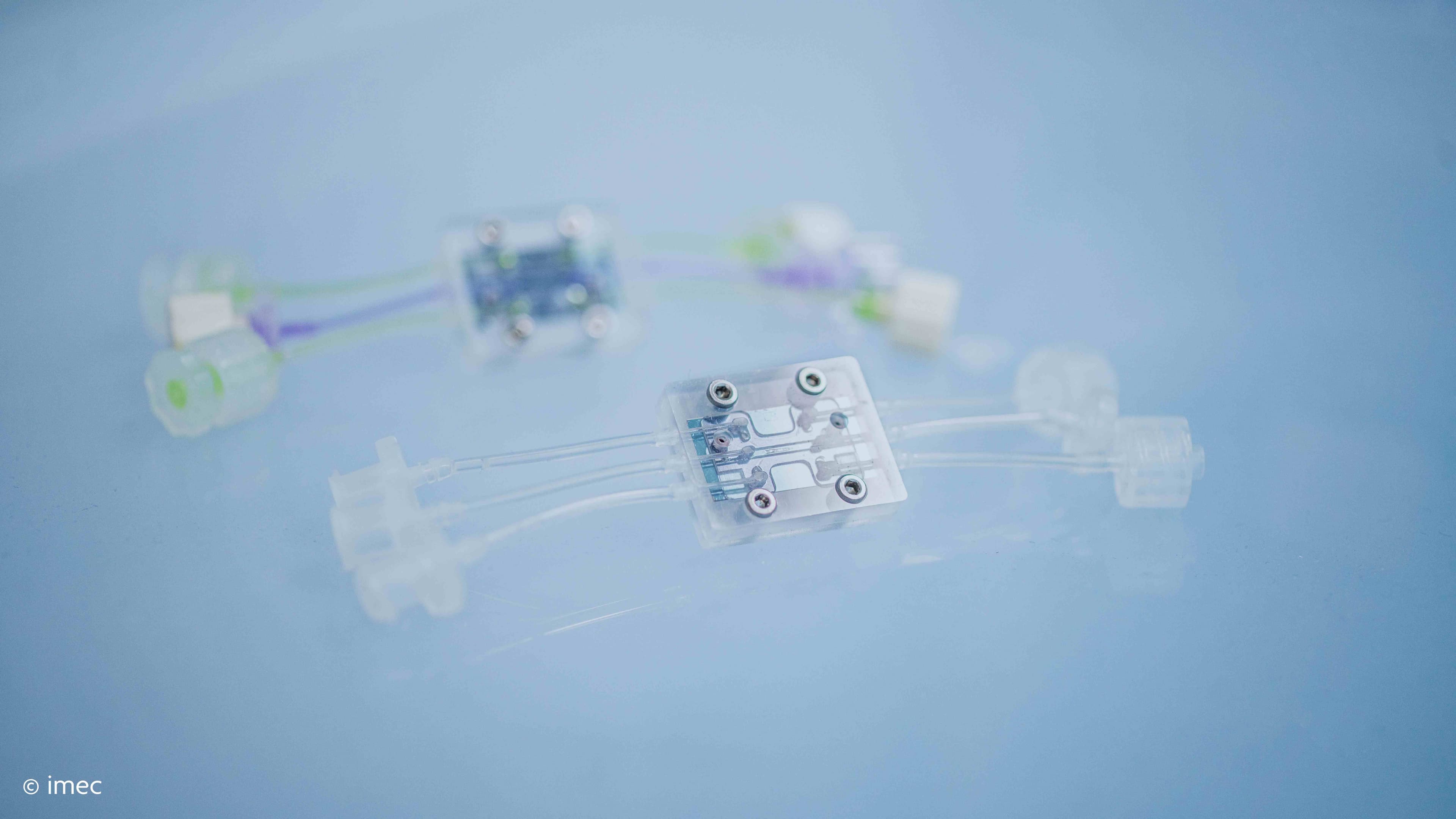

Speckle sensing for continuous health monitoring
Capturing richer physiological data for wearables and contactless care.
The future of vital signs monitoring relies on richer biomarker detection that performs well across diverse populations, powered by sensors small and power-efficient enough for everyday wearables. To meet these demands, imec is pioneering speckle sensing, a laser-based optical measurement technique, leveraging its know-how in photonics, algorithms, and integration to transform how we monitor vital signs in a wearable form factor.
Continuous health monitoring, of the kind now built into smartwatches, has relied on a single optical technology: photoplethysmography, or PPG. PPG shines light into the skin and measures how much is absorbed as blood pulses through with each heartbeat. Small variations in intensity are enough to derive vital signs, such as heart rate and blood oxygenation. It is a proven method, used in today’s consumer wearables and clinical monitors alike.
PPG's reliance on absorbed light fundamentally limits its precision. While AI-driven data interpretation continues to advance, achieving clinical breakthroughs in wearable monitoring demand richer data, from sensors that offer higher measurement quality.
To meet that demand, researchers at imec are looking to a new frontier in advanced biometrics. The future lies not in measuring the light absorbed by the body, but in decoding the intricate patterns generated when light is distorted by it.
Speckle sensing: A fundamentally different optical approach
Instead of measuring variations in light absorption, speckle sensing uses a coherent light source (i.e., a low-power laser). When projected onto the skin, the laser produces a fine interference pattern (a speckle pattern).
As blood flows and vessels contract and dilate, photons scatter off the moving tissue and the pattern shifts. Reading those shifts yields a high-resolution, detailed waveform, providing direct insights into cardiovascular mechanics with a quality surpassing the capability of sensors used today.
That change of principle – measuring the modulation of interference rather than light absorption – results in data with distinct advantages:
- No skin tone bias. Melanin in skin heavily affects today’s sensors because it changes how much light can be absorbed by tissue. By focusing on the geometry of a shifting pattern rather than an absolute quantity of returned light, pigmentation has minimal effect on the signals obtained through speckle sensing.
- Data richness. As state-of-the-art optical sensors reach the ceiling of their accuracy and capability, their limitations towards complex biomarkers such as blood pressure remain persistent. With speckle sensing, the potential for richer harmonic content, sharper signal features and stronger responsiveness opens a new frontier in the field of non-invasive health monitoring.
- Reach beyond contact. Because the signal travels in the scattered coherent light, it can be read at a distance without being affected by environmental light modulation, opening the door to contactless measurements.
An important advantage is that the laser power required is very low, far below regulatory safety limits, posing no risk to people when worn every day.
Methodology and early clinical outcomes
Translating interference patterns into accurate and actionable vital signs has required solving complex engineering challenges, primarily in signal processing and motion artifact rejection.
Imec has developed proprietary algorithms to tackle those challenges, and the early functional prototypes are already delivering results:
- Clinical-grade standard vitals: Speckle sensing has successfully measured cardiac vital signs (heart rate, respiration rate, and heart rate variability) with clinical accuracy. Importantly, this has been shown to work both directly on the body and at a distance as a contactless technology.
- Calibration-free blood pressure: Using the high-fidelity speckle data, imec researchers are working on extracting blood pressure metrics without the need for a calibration cuff. This is a major advancement in blood pressure monitoring, and extended clinical trials are now in the works.
- Blood oxygenation (SpO2): Early-stage research is aimed at measuring variations in blood oxygenation without being subjected to skin tone bias, a persistent challenge in today’s pulse oximetry.
The value is not in any single one of these numbers but in the density of the underlying signal: one continuous, high-resolution stream from which many physiological measures can be drawn, and from which more can be extracted as the algorithms mature.
Why wearable speckle sensing takes co-optimization
A data-rich signal in the lab is not yet a product. Capturing spatial interference patterns continuously generates heavy processing loads, and no wearable can carry that load unless the optics and the electronics are built as one system. Designed together, they allow for architectures that neither discipline could reach alone.
To bring speckle sensing into commercial applications, imec is therefore working across hardware miniaturization, optical integration, and ASIC design at once.
Two efforts make this concrete:
- Miniaturized photonics: To fit a wearable, imec's photonics teams are compressing the optical path to millimeter level, leveraging integrated photonics, meta-optics, and advanced packaging.
- Edge compute: To stay within the power budget of a device that runs continuously, imec is building its data-processing algorithms directly into ultra-low-power application-specific chips.
Together, these let the sensor output data and slot into existing wearable hardware, replacing current modules – a drop-in replacement that does not force manufacturers to redesign their devices. It is this integration path, more than any single measurement, which makes continuous speckle sensing commercially viable.
What richer, continuous data unlocks
Combining a dense spatial signal with continuous, low-power capture fundamentally advances measurement capabilities. Instead of watching a trend emerge over weeks, a clinician or the person wearing the device sees blood pressure, respiration rate, or flow in the smallest vessels as it is at that moment, changing in real time. Readings arrive early enough to act on, which turns continuous monitoring into a tool for preventive care.
The same core technology supports several initiatives:
- Global health: Through a collaboration with the Gates Foundation, imec is validating calibration-free blood pressure measurements in low-resource environments where access to trained medical personnel and complex clinical infrastructure is limited.
- Early microvascular dysfunction: In conditions like heart failure and chronic kidney disease, the earliest signs of damage are seen in the microvasculature. While blood pressure only registers this damage indirectly, speckle sensing can track variations within the microvascular system, offering direct and early insights before changes appear on a systemic level.
- Clinical care: In hospital recovery and elderly care, speckle sensing enables untethered, contactless, unobtrusive monitoring, reducing the hassle of cables and cuffs.
Partner with imec
Are you developing the next generation of wearable health sensors or contactless patient monitoring systems? We're ready to help you integrate speckle sensing into your product, offering access to our proprietary algorithms, meta-optic miniaturization, and low-power ASIC design capabilities.
Imec not only helps you to address technological challenges but, thanks to our thorough knowledge of the health and pharma sector, can function as your full-fledged strategic partner — right down to venturing support.
Click the button below to get in touch.